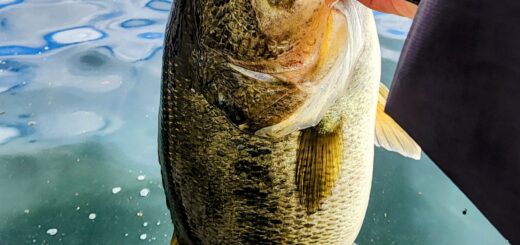
The Pylons Always Win
I’ve started realizing that the more I fish for Spotted Bay Bass, the more they remind me of psychopathic little largemouth living in a saltwater urban housing development. “The Projects,” if you will. They don’t inspect a bait. They don’t follow it politely deciding whether to eat it. They don’t “mouth” the bait. They try to kill it immediately and take off for the hills, preferably underneath the nearest piece of barnacle crusted structure capable of ruining your day.
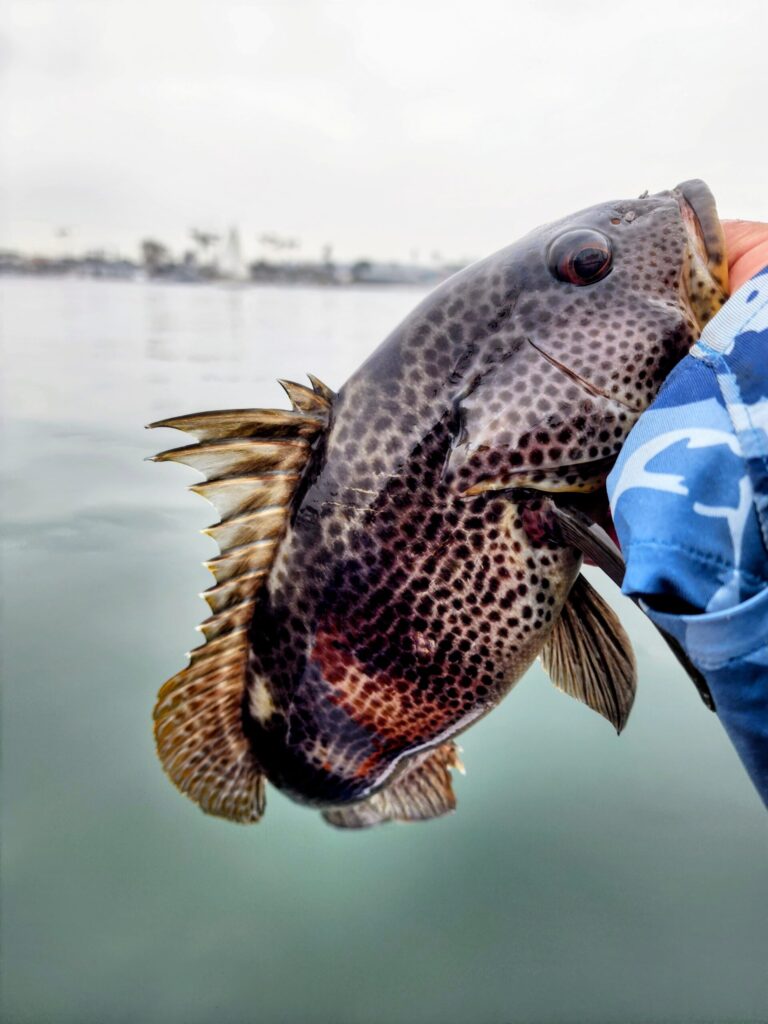
And apparently, the best way to catch them is a technique I spent most of my life avoiding.
I don’t flip. Never have. “Never will!” I told myself.
Southern California isn’t exactly the mecca for producing vegetation-flipping experts, especially when most of your fishing career has been spent standing on shore trying to cast baits into open water. Flipping goes against everything I was taught. “Don’t cast over there, you’re gonna get stuck, dumbass.” Flipping always looked like one of those techniques reserved for guys nicknamed Crawdad running an ’87 Champion with three different shades of sun damage on it, a Johnson outboard held together entirely by zip ties and confidence, using Spiderwire older than me, boat-flipping fish through three feet of vegetation like they were pulling turnips out of a garden.
But lately, approaching fish from a boat has forced me to expand the arsenal a little. So, I dipped my toe in the water.
The FIRST time I got bit flipping, I still had the reel disengaged.
Backlash.
The SECOND time I got bit (months later), I had so much slack out that my hookset accomplished absolutely nothing except almost decapitating OG behind me with my Dobyns 746. “My bad, dogg…here’s your hat back.”
The THIRD bite was success. Sort of.
On TV, you always see the flipping guy setting the hook like he’s trying to yank the fish directly into the boat without physics being involved, with an absolute Slaunch Donkey on the other end buried in the nastiest cover imaginable. It becomes a full-blown tug of war between man and beast of Herculean proportions, with John Williams doing the score.
Somehow, the angler always wins.
He reaches into a floating island of weeds, grass, and tules and pulls out a bass so big you could lose your fist in its mouth, waving it triumphantly in the air while vegetation hangs off the fish like the snakes on Medusa’s head,
MY third bite resulted in a poor 12-inch fish weighing roughly 14.9 ounces being rocketed to the 4th dimension, coming out of two feet of water with his eyes crossed, a severe case of whiplash, and absolutely no idea why it had just briefly achieved breaking the sound barrier; but at that moment I understood the appeal of close-quarters combat fishing. It was immediate. Slapped you upside the head. Addicting. Right up my alley.
The first time we really found a flipping pattern that we could run with was at Havasu a few weeks ago. The tules near the 95 bridge were holding fish — not the right kind of fish as we soon learned, but enough of them to hit the fast-forward button on the learning curve.
One thing became obvious almost immediately:
The bite happens on the first drop.
Either the fish ate it as the bait fell, or within the first shake or two. After that? Dead water. Repeated pitches to the same target felt pointless. Dragging your bait back to the boat? Same thing. If they wanted it, they let you know instantly.
Fast forward to yesterday at MDR. Dock lights still reflected off the black water while yacht owners slept peacefully above the vast ecosystem living below them.
Same concept.
Different psychopaths.
Similar results.
The spotted bay bass acts a lot like its more sophisticated freshwater cousin, the largemouth. The spotted bay bass is just considerably more violent.
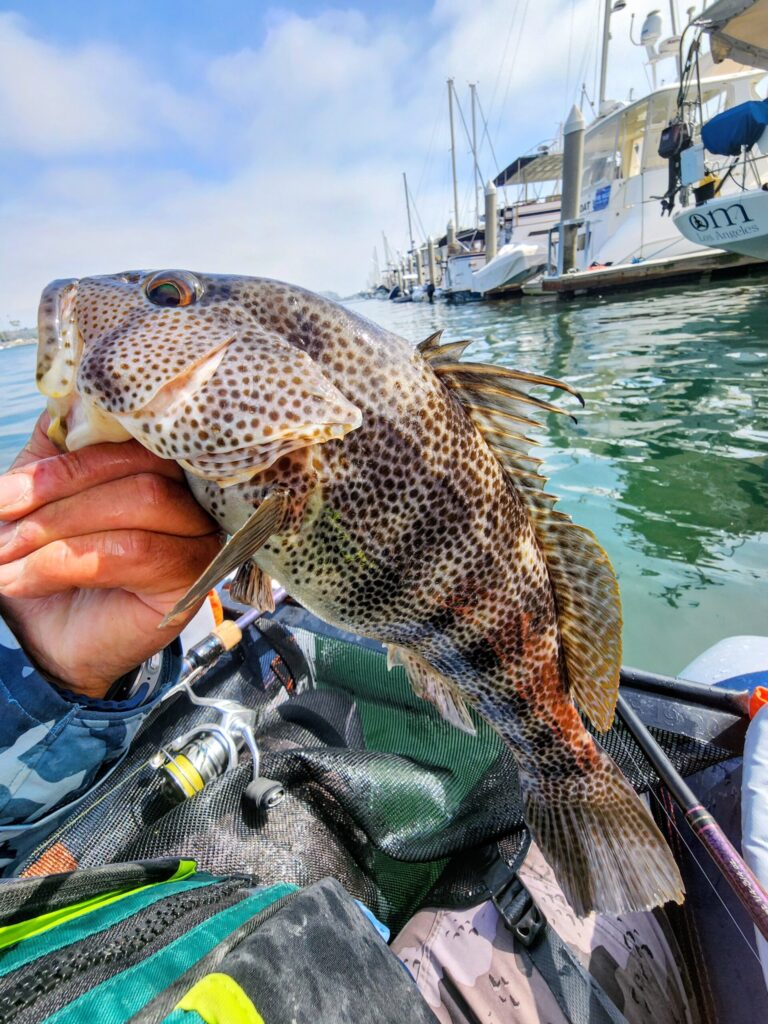
The largemouth is the sophisticated suburban cousin. Ivy League education. “Smart.” Lives in Montebello, and not East L.A. Doesn’t hang around the chusma.
He lives in gated communities full of tules and golf course ponds where the HOA keeps the hydrilla trimmed and the bluegill population properly stocked.
He eats organic bluegill for brunch, studies a bait like he’s reviewing mortgage paperwork, and only bites after careful consideration of water clarity, barometric pressure, moon phase, and line size.
Meanwhile, he’s being chased around by guys in $100k bass boats with electronics packages more advanced than regional airports and equipped with enough sonar technology to locate Atlantis.
The largemouth is refined.
Deliberate.
Pretentious, even. Even his bite is polite.
A Spotted Bay Bass would stab him for his lunch money. They act like they just kicked open the liquor store with a ski mask on.
The spotted bay bass is the cousin that just got out of County and now lives underneath the pylons behind a marina liquor store with a stolen EBT card that has no funds.
He eats out of garbage cans, fights raccoons at night, and somehow always has access to fireworks despite having no legitimate source of income.
Nobody’s exactly sure what they’re doing down there all day, but whatever it is, they’re sure angry about it.
Which would explain why every bite feels like an attempted armed robbery.
He doesn’t inspect anything. He assaults it first. With its mouth.
He’s got concealed weapons everywhere — mouth, gill plates, dorsal spines — and when you finally land him, he locks his jaw shut like he’s refusing to answer questions without a lawyer present. And if you do manage to pry his mouth open, he’ll immediately clamp down on your thumb hard enough to draw blood.
A largemouth fights because he got caught.
A spot fights because he genuinely hates you.
I wouldn’t lend a spottie money under any circumstances.
The first bite of the morning happened within the first minute when a barely legal sandie of all things nearly ripped my spinning rod out of my hands at gray light. I’ve noticed most of the sand bass I’ve caught have come early, right before the marina fully wakes up. I’m sure that means something, but I’m not smart enough to know exactly what yet. That first bite sure beats coffee, that’s for sure.
The spots, though?
Entirely different deal.
If you don’t get bit on your first cast, move.
Seriously.
I’m starting to believe you’re not convincing spotties to bite. They either react instantly out of instinct, or they ignore you completely. There doesn’t seem to be much negotiation involved.
That became the entire strategy for the day:
Hit the dock. Inside lanes, back, and front. Flip the darkest corners. It could be the shadow of a boat, or a pylon. Let the bait fall. Be ready immediately. Now I know why referees tell boxers to “keep their hands up at all times.”
Because if you aren’t prepared for the bite, you’re about to get punched in the face and donate expensive tackle directly to the pylons.
And the pylons don’t care what line brand you’re sponsored by. Don’t tie on anything that isn’t worth losing.
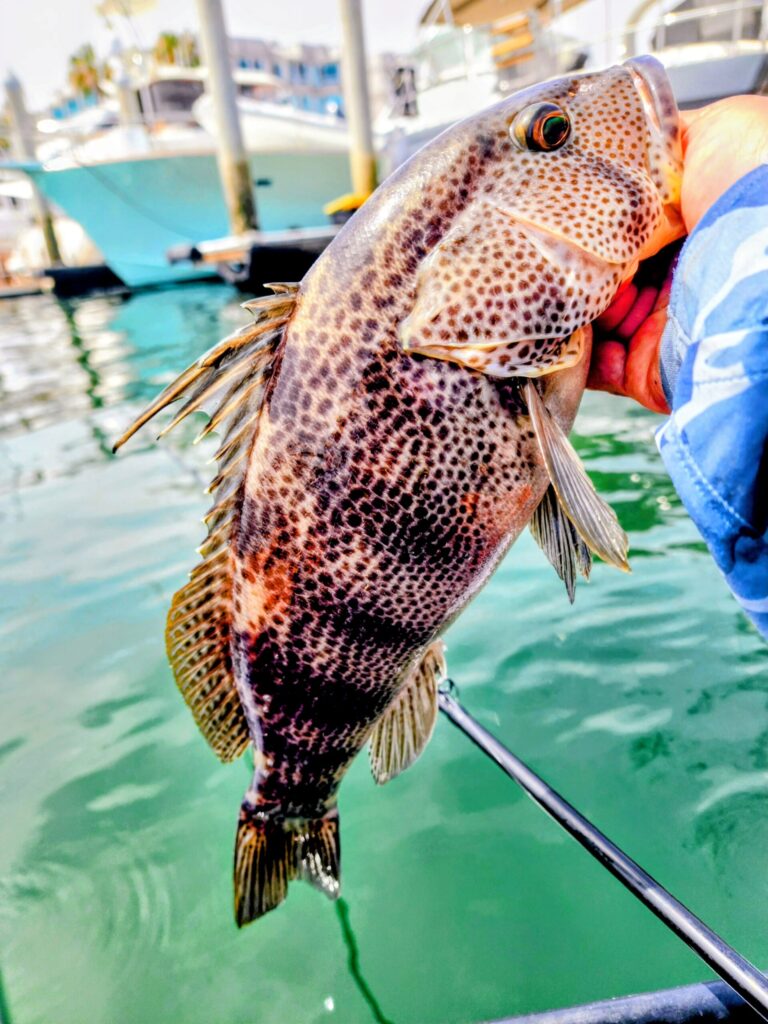
The biggest thing I’ve learned is that landing the fish is about brute force but finesse as well. It’s about angles. The second you get bit, you have to turn the fish’s head immediately which means a serious hookset and winding like if your bait depended on it. You need to also change the line angle before it rubs against hard structure covered in nature’s razor blades.
Which is easier said than done in 15 feet of water. I’ve pulled fish out of the pylons and became lazy with the pressure and had them dive back into them and *POP.*
Flipping shallow freshwater tules is one thing. Soft cover ain’t shit. Doing it around marina docks feels like trying to fight a PCP’ed Freddy Krueger inside a ’76 Civic.
If you had a bit of slack, or the fish already was headed in that direction, suddenly you’re yelling:
“FUCK!”
while people drinking coffee on million-dollar yachts look down trying to figure out who the Mexican is underneath them.
“What seems to be the problem, buddy?”
“Nothing sir,” I said. “Just lost a nice fish around that pylon.”
“Yeah well…just make sure your hooks don’t puncture my rubber boat. You see that flat one over there? A fisherman punctured that one.”
“Well now, that is decidedly unfortunate. Did you happen to give that young scallywag a proper stern talking-to, in the fine tradition of our forefathers?” I said in my whitest voice I could muster.
“Well…I didn’t actually see him.”
“So how do you know it was a fisherman’s hook, dick?” Some things you just think and not say.
…
“…Just don’t fish near here, okay?”
I kept on fishing near there. Apparently, some people own sections of the Pacific Ocean now.
Despite the chaos, the pattern held up all day, minus a 2 hour period where the bite went completely dead. This also coincided with very little current, which makes sense. Ten solid keepers hit the deck, or my stripping apron rather, plus another fifteen or so smaller fish that didn’t exactly deserve photography rights. For MDR, where “good fishing” usually means surviving three hours without getting bit by a loose seal, or getting run over by a boater who doesn’t know what NO WAKE means, the bite was actually ok.
More importantly, though, things are starting to connect and my theories are beginning to hold water.
The same first-drop reaction bite I saw at Havasu showed itself again in saltwater. The same instinctive aggression. The same need for precise boat positioning (or float tube positioning in my case) and immediate control after the hookset.
Different fish. Same set of rules.
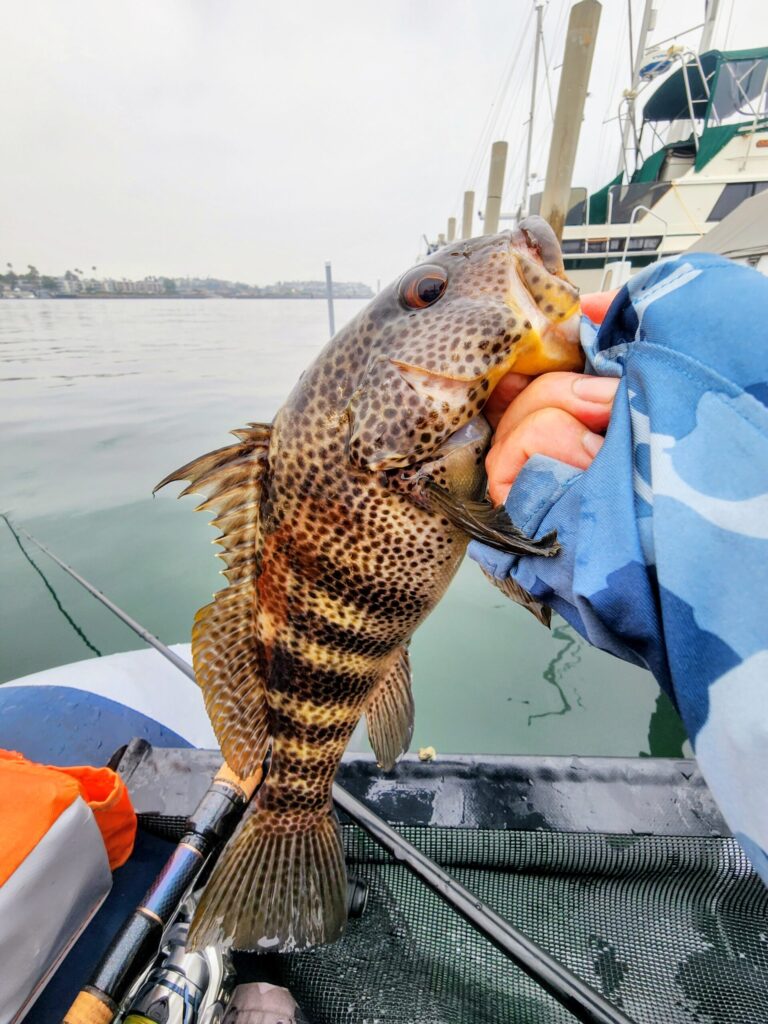
Ten hours into the session, I realized the best patterns in fishing usually aren’t complicated. They’re observations repeated often enough to become confidence.
One bite on the first drop becomes coincidence. Twenty bites on the first drop becomes understanding.
That’s really what keeps me coming back out here. Not numbers. Not photos. The process of slowly connecting pieces together.
Learning how a fish positions. Spotties love structure. Learning how it reacts. Spotties are sociopaths. Learning how quickly chaos can happen underneath a dock in MDR. Underneath all those pristine million-dollar docks, spotted bay bass were wandering around, looking for the next victim.
The spotted bay bass may live in saltwater, but the lesson felt familiar:
The fish usually tell you exactly what they want.
If you’re paying attention.
One sharp:
THUMP.
Or nothing at all.
Move on.
Honestly, I respect that level of honesty in a fish.
Just make sure your reel is engaged when they decide to tell you.