The Concrete Blueprint: Decoding The Vertical Spottie Game
I see a lot of guys posting float tube reports down in San Diego targeting natural bays and estuaries, fan-casting swimbaits, and slow-rolling moving baits across acres of eelgrass filled flats and channels. Even down in Newport, anglers get to fish natural shorelines, sweeping flats, and current-cut channels.
Not here. Inside this marina, we’re playing an entirely different sport.
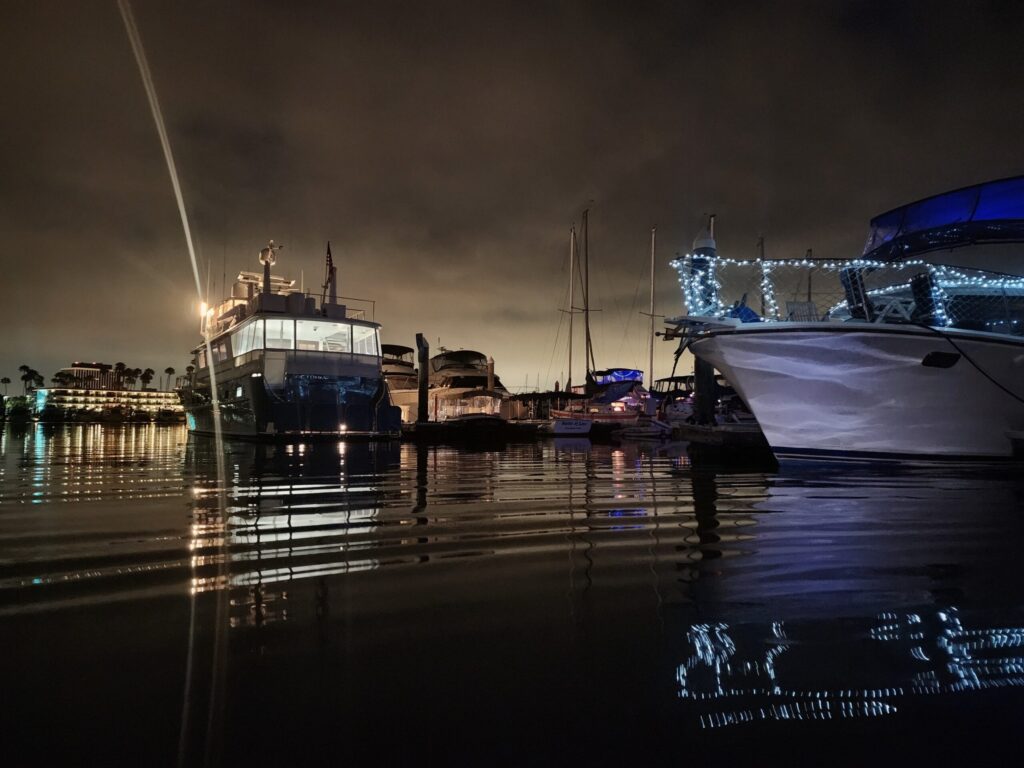
We don’t have open flats or massive eelgrass meadows out here. This place is a rare beast—a strictly human dredged, tight-quarters, high-flow concrete bathtub designed for maximum boat capacity and minimal habitat; the biggest in the world by that measure. It is a completely vertical, close-quarters world where current, structure, and positioning matter far more than covering water.
After logging various 10-to-12-hour sessions at exactly zero feet above sea level in the float tube the last 2 months, I’ve laid out a small technical blueprint of sorts for breaking down a pure concrete marina estuary.
1. The Bathymetry: Pure Micro-Canyon Hydrodynamics
From a satellite view, a marina basin looks like stagnant, uniform swimming pool water. From above, the tide is simply moving “in” and “out.” Drop a float tube into it and that illusion disappears immediately. Drop a line straight down from that float tube, and the illusion becomes even more baffling. This concrete box functions exactly like a raging, high-volume trout river—just with more multi-million-dollar maritime tax write-offs floating on top.
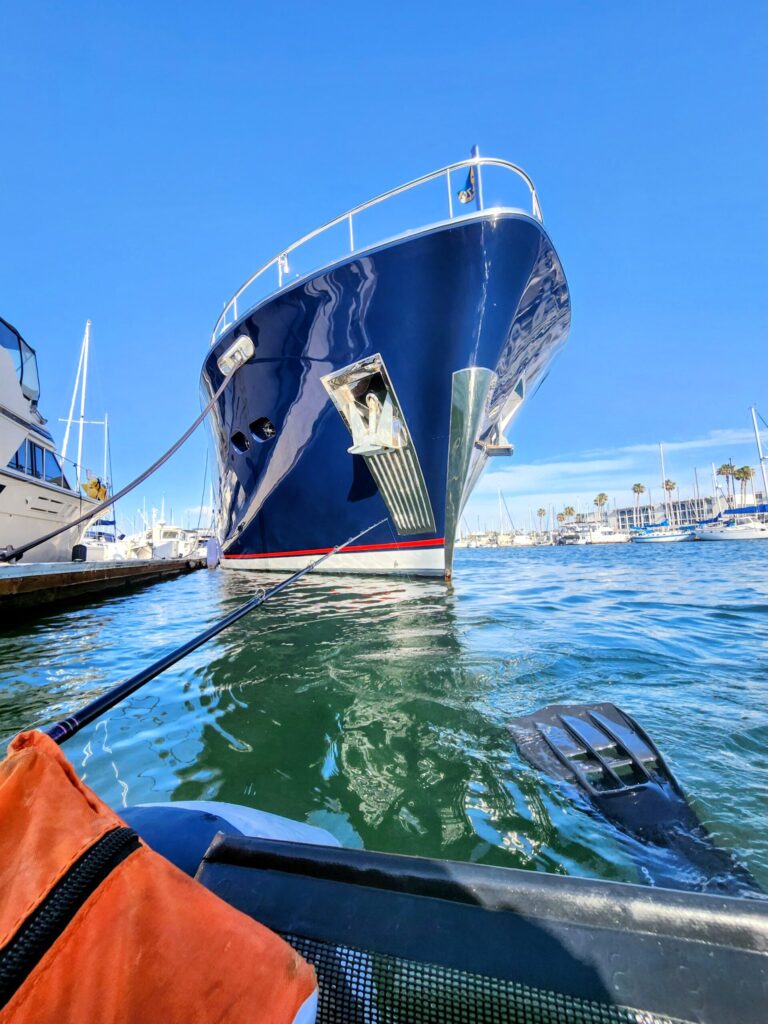
Because the harbor is entirely dredged and highly uniform, the smallest underwater anomaly—a concrete block, a dock corner, a recessed slip, or even a large hull shape—creates surprisingly complex current behavior. You can make a cast, watch your line sweep hard to the left, then pitch ten feet away into a completely different seam where the current is actually moving in reverse.
What looks featureless from above often behaves like a miniature river system below the surface.
- The Horizontal Contrast: Natural estuary and bay anglers can often drift with the wind across broad flats while covering water. If you try that in a small harbor or marina, there’s a good chance you’ll end up underneath a yacht bow or get run over by a moron who just rented a jet ski, with no boater’s card.
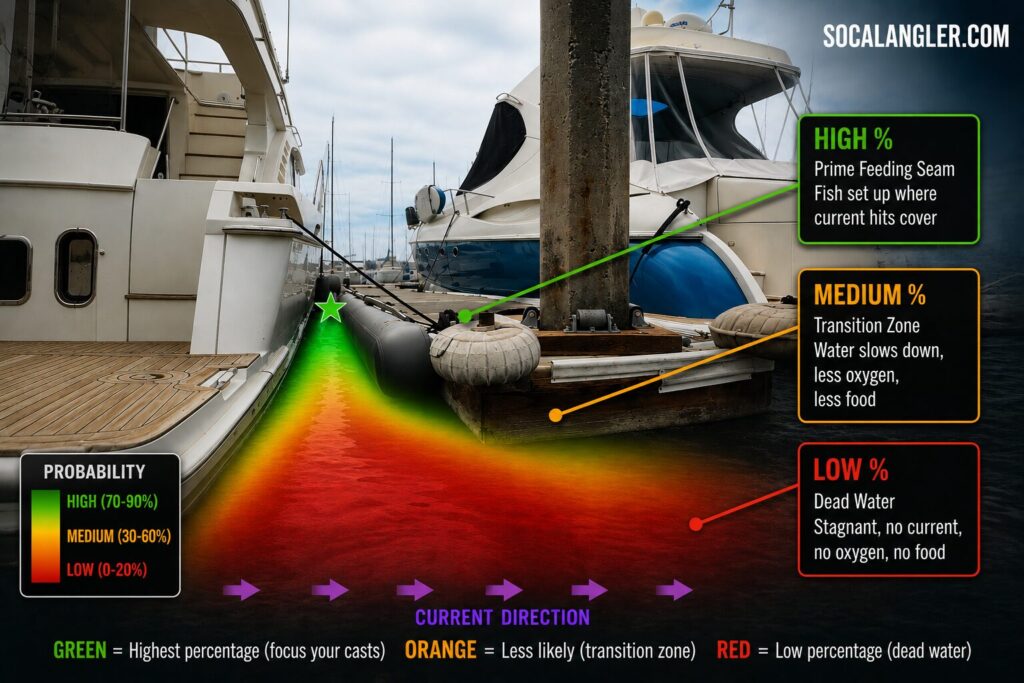
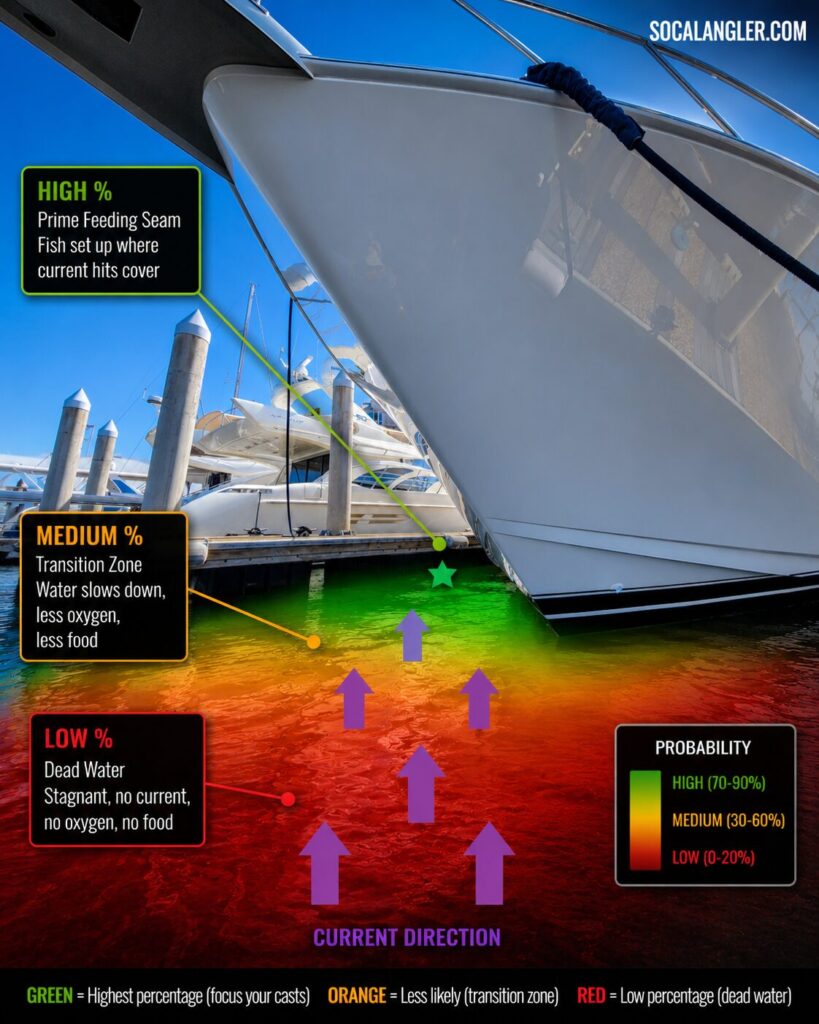
- The River Approach: In a tight basin, you read current seams the same way a fly fisherman breaks down micro currents in a trout stream. For the most part, you’re casting upstream into subtle eddies, maintaining contact during the drift, and allowing the bait to move naturally into the dark shadow pockets where predators are positioned. Much like you don’t cast a dry fly on TOP of where a trout is rising, you’re casting up-current of where these quality fish will be positioned.
2. The Behavior: A Reaction-Strike Fishery
If you’re used to freshwater largemouth or open-water saltwater bass, hard structure spotties operate a tad differently. These fish here spend much of their lives buried inside dock systems, concrete walls, and shadow lines where current funnels food directly to them. Because of that, the strike window is extremely small.
- The Zero-Negotiation Window: This is almost entirely a reaction-strike game. Fish positioned deep inside heavy cover make split-second decisions. They’ll either eat the bait as it falls through the strike zone or hammer it within the first few movements after it reaches bottom. If nothing happens during that initial presentation, the odds drop dramatically.
- The Landing Problem: Getting bit is often the easy part. Landing them is where fish are lost. A spotted bay bass hooked next to concrete immediately tries to change the angle of the fight. Every surge is directed toward a piling, dock float, seawall edge, or hull. Once they’re in open water they’re manageable. The first few seconds determine everything.
- The Efficiency Rule: Don’t spend all day dragging a bait back through empty water. If the fish doesn’t commit during the initial drop or first few movements, reel up, move a few feet, and attack the next piece of high-percentage structure.
3. The Gear: Built for Abuse
If you think you need a wrapped boat and electronics package that rivals SpaceX to catch these fish, the tackle industry would be thrilled to hear from you and your wallet. My setup is considerably less sophisticated.
- The Boat: Outcast Fish Cat Max 5: Without this thing, the entire vertical marina game is impossible. It’s a big, stable, zero-frills floating fortress. It features dual bladders—crucial insurance for when a local sea lion mistakes your backside for a snack—and maneuverability that is lightyears ahead of the traditional U-shaped float tubes or the glorified life savers I used to kick around in the 90s (looking at you, Browning). It’s remarkably light for its footprint, and the full-foam seat actually keeps you high on the waterline. No more stacking phone books under your ass just to keep your nostrils above sea level. Best of all, Outcast’s customer service is legendary. You call them, and an actual human answers. None of that, “We’re owned by a private equity firm that bought out twelve other inflatable brands and we don’t know what a float tube is” nonsense.They haven’t been swallowed up by an international conglomerate that manages inflatable boats and commercial real estate portfolio metrics.
- The Casting Hammer: A 7’2″ heavy-action Powell Endurance. A glorified broom stick. Longer rods become cumbersome in a float tube, especially when you’re pitching underneath docks and around moored boats. My eyes are barely above the waterline. I look like Cheech Marin driving his lowrider in Up in Smoke.
- The Winch: An old-school Shimano Chronarch 100B. Heavy, simple, and built before everything needed a marketing department. It isn’t fancy, but it survives saltwater abuse and endless close-quarters fights around structure. Micro gears? Good luck.
- The Mainline: Straight 12-pound Seaguar Red Label fluorocarbon, or whatever crap is on sale. It survives barnacles, dock cables, and concrete better than most people would expect, although it’s as thick as those aforementioned dock cables. It’s also cheap. I change line quite a bit here as I’m constantly cutting off frays.
The ‘Finesse’ Rod: A 7’2″ Medium Extra Fast Phenix M1. This is a rod I actually won in a raffle, and it handles beautifully. It’s light and remarkably thin for its power rating, yet it’s stiff enough to pull these fish directly out of the structure.The Little Spinning Reel that Could: A Shimano Stradic C2500S. JDM shallow spools are extremely convenient and cost-efficient because you aren’t wasting cash packing 300 yards of 8-pound test onto a massive spool.The Mainline: This is paired with 16-pound Sunline Almight braid in camo, connected to a 9-pound Sunline Shooter leader. I’ll gladly spend money on high-end braid and a short leader before I spend money respooling an entire reel out here.
3B. The New Gear: Out With The Old… (And Into the Drink)
Editor’s Note: As of writing, that spinning combo mentioned above is currently residing at the bottom of the marina floor, serving as a very expensive artificial reef for the local crustacean population. RIP Phurple Rain. You were dialed in right up until you weren’t.
Naturally, I walked into the tackle shop intending to replace one spinning setup and inadvertently walked out with an entirely new casting set up as well.
Why the sudden upgrade? Simple: I’m logging 12-hour days in a floating canvas donut re-experiencing a type of fishing I had forgotten about. I started with budget beater gear to make sure I actually liked the float tube life. But at this point, if I’m going to live at exactly zero feet above sea level, especially this summer, I’m going to drop some coin on the tools I rely on most.
The actual TL;DR: Because I can.
Here is the new line-up:
- The NEW Casting Hammer: A 7’2″ MH Fast Shimano Expride B. A massive evolutionary leap from my decade-old Powell. It’s lighter, violently sensitive, and features a hook keeper that doesn’t actively try to snag every piece of line within a five-mile radius. Most importantly? Zero cork. When a spotty panic-vomits its morning meal of ghost shrimp all over the handle, you don’t want a porous organic material absorbing that crime scene. The monocoque carbon grip cleans right up.
- The NEW Winch: A Shimano Tranx 150XG. Praise be, I think this is the only reel Shimano makes that hasn’t been infected by their ‘famed’ plastic-feeling micro-gears. It feels like a feather compared to my old Chronarch tank, and the blazing fast 8.1:1 gear ratio lets me vacuum up line when I’m distracted by someone’s dog and some angry harbor bass is trying to lace my fluorocarbon through a rusty dock pilon.
- The Mainline: 30 yards of Sunline SX1 braid backing spliced to 75 meters of 14-pound Sunline Shooter fluorocarbon, straight. Life is too short to fish shitty, cheap FC. Sorry, not sorry.
- The NEW ‘Finesse’ Rod: A 7’3″ Medium+ Fast Shimano Expride B. This matches the casting rod’s lineage, drops a ton of weight off the old Phenix M1, adds massive sensitivity, and once again: zero fish-puke-absorbing cork.
- The NEW ‘Finesse’ Reel: Okay, so I recently discovered that a Stradic C2500S that went snorkeling at the bottom of the marina was not a true 2500. It’s a 1000-sized spool body masquerading as a big boy. For the past six weeks, I have basically been doing hand-to-hand combat with heavy concrete structure and angry fish using a glorified trout reel. No wonder I felt undergunned. I corrected the error and procured a true-frame Stradic 2500S. Hopefully, this one avoids joining Phurple Rain twenty feet under my fins.
- The Mainline: Kept it consistent—16-pound PINK Sunline Almight braid topped with a 9-pound Sunline Shooter leader. I like the bright pink line. I see all the cool saltwater guys doing it. Deal with it.
4. Baits: Anything Resembling Harbor Food
Choose whatever bait you want, seriously. Once the current moves, these fish reveal themselves as shameless, bottom-feeding mongrels content to rummage through the industrial muck for anything moving. If you sit there overthinking your bait and color selection like it’s a fine wine pairing at a Michelin-star restaurant in Santa Monica, you’ve already failed. The longer I fish this place, the less I obsess over lure selection. Every session does start out the same way though: I tie on something expensive, difficult to replace, or imported from Japan, or all 3. The fish usually destroy it before I can get my heart rate down from the kick out. I chuckle and then I start throwing some Ozark Trail type of stuff. “Because it’s cheaper!”
The Toll: Premium plastics rarely enjoy a long life expectancy around marina bass. Between short strikes, violent eats, dock structure, and fish with surprisingly sharp dental equipment, many of them survive one bite, and if you’re lucky, one fish. Your ROI is terrible with pricey plastics.
The Tide Dictates Position, Not Preference: I’ve caught fish on premium JDM plastics, bargain-bin freshwater leftovers, and a piece of a KIND bar that I had in my compartment. The larger variable isn’t what they’re eating—it’s where the current positions them.
During slack water they often bury themselves tight to concrete walls and dock infrastructure. They don’t swim far for food. Why would they? Mother Nature starts up the conveyor belt twice a day for them. Once water starts moving, they slide into seams, corners, transition points, and current breaks where food gets delivered directly to them. The tide doesn’t determine whether they’re willing to eat. It determines where they’re willing to eat and how far they’re willing to travel.
5. Tube Positioning: Physics Over Friction
Pitching into commercial marina infrastructure from a float tube isn’t a relaxing experience. Every fish hooked around concrete immediately turns into a geometry problem. In a vertical harbor environment, line friction becomes the enemy. You can’t sit back and enjoy your fight until you get them from out the octagon.
When a fish eats in fifteen feet of water, its first instinct is usually to dive toward the nearest abrasive surface. The moment that heavy thump travels up the rod blank, you need to execute an immediate sweeping hookset away from the structure and start gaining line. You’re not simply fighting the fish; you’re fighting the structure surrounding it.
The Downstream Trap
The biggest positioning mistake float tubers make is setting up downstream of their target. When you’re positioned below the structure, current creates a large bow in the line and pushes fluorocarbon back directly against the abrasive face of pilings, seawalls, and dock corners.
When a fish bites, the hookset must travel through slack. Once the line comes tight, it immediately begins grinding against concrete and barnacles. And you break off your Walmart bait.
The Up-Current Fix
The solution is often as simple as changing your angle by a few feet. Position your tube slightly up-current of the specific piling, shadow line, or seam you’re targeting. Pitch upstream, maintain contact during the fall, and allow the current to carry the bait naturally into the strike zone.
When the fish eats, the hookset pulls its head away from the structure and into open water instead of deeper into the hazard. You’re using the current itself to improve your landing percentage. Small adjustment. Huge difference.
6. The Footprint Paradox: Why More Rigging Equals Less Access
Look around any Southern California marina today, and you’ll notice the classic paddle kayak has gone extinct. In its place is a fleet of mini-destroyers: fourteen-foot rotomolded plastic hulls packed with lithium batteries, bow-mounted trolling motors, side-imaging sonar arrays, and vertical rod racks that resemble a medieval picket line. They aren’t kayakers anymore; they are just boaters with less dry storage.
Sure, they can blaze across open water at five knots and map every Miller Lite can on the harbor floor in 3D. But inside the tight-quarters vertical game of a commercial marina, their massive footprint is a liability That’s why they’re all throwing A-Rigs in open water. They can’t get into the spots the FishCat can..
- The Tight-Corner Premium: The biggest spotties in the harbor don’t live in the open lanes where a fourteen-foot rig can easily hover. They live in the structural blind spots—the dead-end corners of recessed slips, the narrow gaps behind commercial docks, and the literal shadows where dock infrastructure meets a concrete seawall. The harder it is to get to, the bigger the resident.
- The Geometry of Stealth: Try backing a motorized rig into a three-foot gap between a million-dollar hull and a barnacle-crusted piling while managing twelve rods sticking out of your crate like a peacock’s tail. It doesn’t work. You’re either scraping fiberglass, fouling your motor prop in shallow debris, or letting the wind blow your massive profile right through the zone before you can even make a pitch.
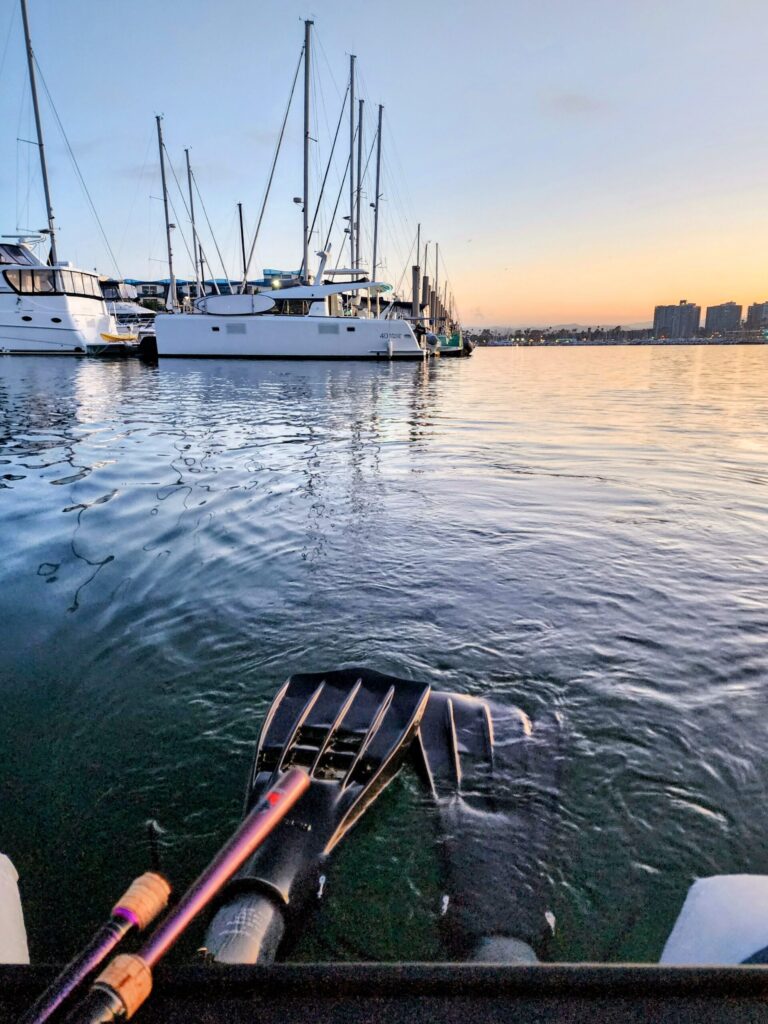
This is where the float tube operates with zero friction. With your eyes at waterline level, you have a turning radius of exactly zero feet. You can back into a dark pocket, lock your fins against a piling to hold against a ripping current, and execute a stealthy underhand pitch into a zone that a motorized kayak can only look at from twenty feet away. They have the electronics; you have the access.
Final Thoughts
If you want to fish the concrete jungle, you have to accept the rules of engagement.
Everything here happens at point-blank range. The strike window is measured in inches, the current moves like a mountain stream trapped in a plumbing fixture, and your margin for error is exactly zero. You will get sucker-punched out here—whether it’s a three-pound spotty executing a textbook break-off on a rusty dock cable, or a yacht owner screaming about his hull wax from a flybridge. It’s all part of the entry fee.
But the moment you stop looking at the marina as a random collection of boat slips and start reading it as a living, breathing hydraulic matrix, everything changes. The concrete walls stop being obstacles and start becoming predictable ambush points. The pilings become current breaks. The shadow lines become borders.
Once you dial in your angles and master the vertical game, you realize you don’t need a hundred acres of open water or a motorized platform to find quality fish. You just need a pair of fins, some stout rods, and the willingness to take the fight directly to the structure.