Well, Shit. We Won.
I was parked on the windy shoulder of the 138 freeway, probably not the most ideal spot for vehicles and trailers to be sitting in the dark. The main gate for the lake isn’t open at 5 am, so I became the last car in the already-forming line. It’s hard to take a nap when there’s the possibility of someone crashing into you from behind at 80 miles an hour, but eventually another truck and boat pulled in behind me. That was my tournament partner, GMoney, and his 1998 Champion.
I put my gear in his boat, and at 6:15 am, we were launching at Lake Silverwood, September’s stop on the WCBA Tournament Trail.
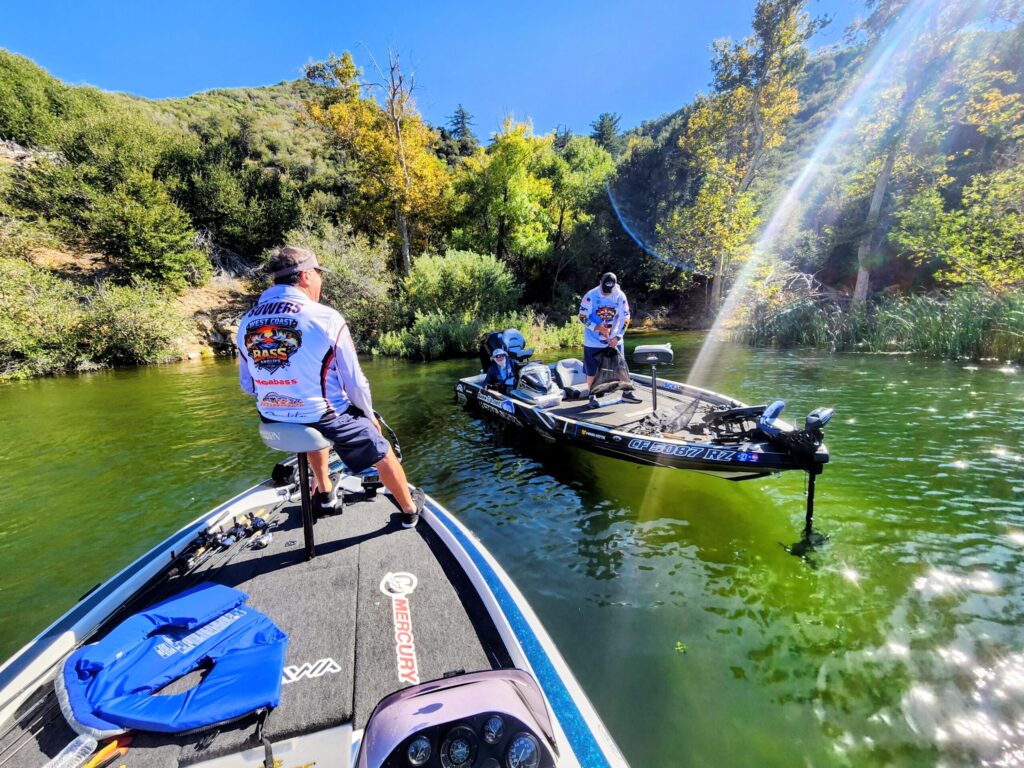
On my second cast of the morning, I had a good blowup on the topwater and was immediately reminded of the day at the Unnamed Marina when I caught a nice spotted bass on a spinnerblade on my second cast, then proceeded to waste an hour flinging that thing without another bite.
This time proved to be different.
Sure enough, on the subsequent cast, a fish stuck. A nice 8-inch striper, who stabbed me with their dorsal fin on the way out. And then another. And another. I was quickly reminded of Silverwood’s schoolie striper population, and after shaking off the fifth striper in 10 casts, I ditched the topwater and started working a different section of the water column.
I got bit on the jig early, but I blame my downward spiral into spotted bass fishing for not setting the hook. It was one of those mushy bites where your brain sits on the fence, wondering whether to swing or not.
In the big pond, there is no mushy bite. They come up and try to kill whatever lands within mouthshot and fits in said mouth. There is no finesse. This largie apparently decided to wine and dine my jig, cuddle gently with it, and see where things went. By the time I realized what was happening, the relationship was already over. I had no one to blame but myself for not setting the hook.
But my inability to pull the trigger did have one positive: I now knew they’d eat the jig.
And as my previous trips to the salt have proven, you don’t have to ask me twice to throw a jig when the jig bite is on. It’s like asking a crackhead if he wants to hit the pookie.
GMoney and I got into various great philosophical discussions about the jig and how, much like many things in life, it’s easy to use when you keep it simple. Learning to fish it, however, isn’t simple. Humans tend to overcomplicate things.
Sure, it looks simple, and once you’ve done it enough, it becomes second nature. But start breaking it down, and there are enough variables to make most people’s brains crash out.
Jig head type? Football, casting, swimming, swinging, round, or some weird JDM creation. Different heads excel in different types of cover and presentations.
Size? Are you using a 3-gram finesse jig to get finicky smallmouth off beds in clear water at Havasu, or a 1.5-ounce bunker buster to flip through the mats in the Delta? Do you need to get to the bottom quickly, or let the jig fall slowly enough for suspended fish to get a better look? Is the wind, current, or depth making it difficult to feel the bottom?
Color? Are you imitating bluegill, shad, or crayfish? What color are the crayfish in the lake you’re fishing? Are you considering low-light conditions, where a darker pattern might stand out, or direct sunlight, where a more natural presentation might make sense?
Retrieve? As I told Gerald, “We can spend the entire day just talking about retrieves.”
These were the conversations where I’d occasionally swing on a fish and hope it was bigger than the two-pounders we’d been catching.
Most people won’t go through all that thinking, rightfully so. They’ll grab any ol’ 3/8-ounce black-and-blue jig from their local tackle shop because Bill Dance catches bass on black-and-blue jigs, slap on a trailer, crooked, I may add, and start flinging that thing at their local lake for hours without success. Eventually, they’ll break off on a snag, having worked the bait like a crankbait.
They’ll say, “Migz was full of shit,” and never fish the bait again.
Then there’s the brush guard. Do you like Keitech’s lighter guards, thicker guards that might need trimming, or the titanium guards Deps uses? Do you even need one? At the Unnamed Harbor, I can get away without one. At San Vicente, throwing a jig without a brush guard is an exercise in financial futility, as you’ll snag every quagga-mussel-infected piece of structure on every cast.
Then there’s skirt material, trailer selection, and the eternal lead-versus-tungsten debate. How quickly do you want the bait to sink? How much movement do you want out of the trailer? Are you trimming it to create a smaller profile?
Lead will catch fish. But once you’ve experienced the connection you get from tungsten, it’s hard to go back. When you’re dragging a jig in 30 or 40 feet of water, that extra sensitivity can matter. Sometimes a bite is nothing more than a tick, and that little bit of extra transmission can make the difference.
This was the conversation Gerald and I had throughout the day, especially once the fish let us know we’d be throwing the jig the majority of the time.
The wind came up at times, which created visions of an amazing reaction bite in my head. Visions of us flipping 4-pounders on jerkbaits and spinnerblades began running through my dehydrated brain. We both gave that bite a shot, only to run into fish who wanted absolutely nothing to do with chasing down moving food. Perhaps the full moon shut that particular bite down, if there even was one.
Instead, we kept coming back to the jig.
And then we started figuring out something more important than the bait itself.
The fish were in a very specific type of place. We were looking for 15 to 20 feet of water that dropped off relatively quickly, rather than some long, gradually tapering sandy point. That structure needed to be adjacent to deeper water, and it needed rock. It didn’t have to be a giant pile, either. Isolated rock would do. A big chunk of rock would do. If it gave the fish something hard to sit around and quick access to deeper water, there seemed to be a fish there willing to eat.
The Ika was getting bit, too. GMoney caught a few fish on it, but they were smaller, generally around the 1.5- to 1.6-pound range.
And that’s where the tournament started getting interesting. Because catching fish isn’t necessarily the same thing as catching the fish you need.
We had five in the boat by around 7:30 in the morning. That changes your entire day. You’re no longer fishing just to get a limit. You’re fishing to cull. You’re not trying to figure out how to catch a fish. You’re trying to catch a better fish.
GMoney recognized that pretty quickly. The Ika was getting bites, but the jig was getting better fish. So instead of continuing to throw the Ika because it was producing, he pulled out a jig similar to my color scheme, just a little larger.
He put it to work and eventually put a 2.6-pounder in the boat, which ended up being our biggest fish of the day and cemented our five-fish limit.
He could have kept throwing the Ika and probably continued catching 1.6-pound fish. But why? We’d already learned something. The fish were willing to eat the jig, and the jig was giving us a better class of fish.
That was the kind of day we had. We backed up each other’s ideas and decisions. If one of us figured something out, the other didn’t have to prove the theory wrong by spending another two hours doing the exact opposite. We tried things, learned from them, and moved on when something wasn’t giving us a reason to keep doing it.
I still threw the other stuff. I rifled through the drop shot, the 4-inch Senko, the 3/16-ounce Texas rig, and the heavier pitching rod when the situation called for it. But I wasn’t trying to force-feed those baits to fish that had already told me what they wanted, like I do on other Saturdays.
And that’s something I’ve been thinking about more and more when I fish tournaments. I have a tendency to make the whole damn thing much more complicated than it actually is.
I’ll start thinking about what weight we’re going to need to win, what everybody else is doing, whether we’re on the right pattern, whether we should be throwing a reaction bait, whether we’re too shallow, too deep, too slow, too fast, whether somebody else is catching them somewhere else, and about 900 other things that have absolutely nothing to do with the fish currently sitting in front of me.
The reality is much simpler.
The first goal of a tournament is to catch one keeper.
That’s it. You don’t need 20 pounds. You don’t need five fish. You don’t need to know how you’re going to win. You need one fish that measures, then another, and another, until you’ve got five. I tend to work backward sometimes, and that’s what causes me to try to start fitting round pegs into square holes.
Once you have five, the equation changes. Now you need to replace one.
For a while, we had two 1.5-pound fish hiding in the livewell like stowaways in the Champion. I started thinking about them in terms of what we needed our final bag to weigh.
Fuck, we need to cull these two because we need at least 13 pounds.
But that’s not really the problem.
We didn’t need 13 pounds.
We needed one fish bigger than one of those 1.5-pounders.
That’s it.
And I actually had to tell myself, Dude, this ain’t Newport. You don’t have the luxury to catch two 2-pound spotties on one cast. You need ONE two-pound fish. What gives you your best chance of catching that one fish?
The answer kept coming back to the jig.
We’d already caught enough fish to know the pattern. We knew what kind of structure we wanted. We knew the Ika could catch fish, but the jig could catch better fish. We weren’t getting a ton of bites on the jig, but we didn’t need a ton of bites.
We needed one. And then another one.
I lost three tungsten jigs during the day, which sucked, but I’ve gotten pretty good at not having an emotional attachment to fishing tackle. A 3/8-ounce Keitech football jig can be replaced tomorrow. It’s not like I lost my signed VHS copy of Don Iovino’s Doodlin’.
Eventually, we culled the two little fish and ended the day with about 12 pounds unofficial on the Bubba Scale. Gerald and I both muttered something along the lines of, “Meh, that’ll put us in the middle of the pack.”
I even threw out a facetious sounding, “Yeah, imagine if we even cash a check at 3rd!”
At the end of the day, it turns out a lot of people struggled. Some teams had three fish. Some guys had three bites. Some guys didn’t even catch a keeper.
Meanwhile, GMoney and I had caught about 15 fish and culled ten of them. We were pretty surprised when they told us 12.5 pounds was enough for first.
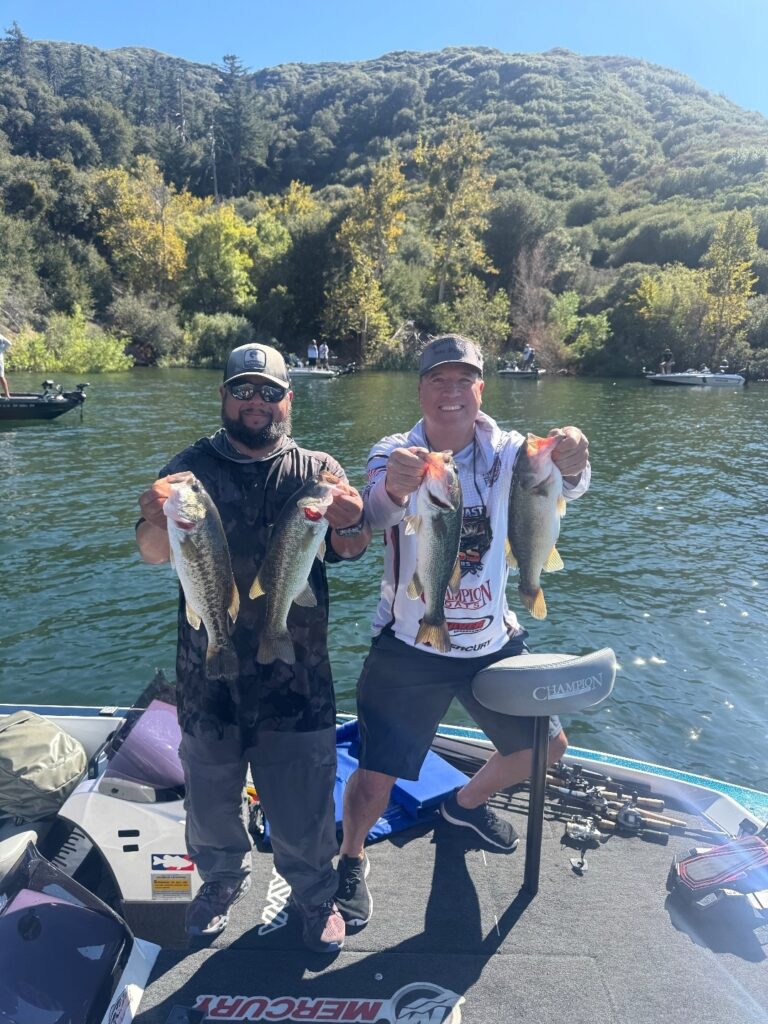
My first win with the new club, and my first time fishing Silverwood from a boat. Which is probably a good reminder that I don’t need to spend the three weeks before every tournament mentally simulating every possible fishing scenario known to man.
Having five fish early made the rest of the day considerably easier. We weren’t trying to catch fish anymore. We were trying to catch better fish. And once you frame the problem that way, the options get a lot narrower.
So there you have it. We spent all day discussing jig head geometry, skirt materials, brush guards, trailer hydrodynamics, tungsten transmission, crayfish coloration, depth, structure, wind, moon phase, forage, and approximately 46 other variables.
And the actual winning formula was:
Throw a green pumpkin jig at the rocks.
Sometimes fishing is complicated.
Sometimes it’s not.
I’m sure I’ll forget that before the next tournament.